Scoliosis in Spanish Fork Teenagers: A Cadence Chiropractic Guide to Screening, Monitoring, and Care

The phone call usually starts the same way. The school nurse sent a note home, or the pediatrician noticed something during a sports physical, or a parent watched their teenager pull a shirt off after practice and saw that one shoulder blade sat higher than the other. The word scoliosis comes up, and the family does not know what to do next. Cadence Chiropractic sees this pattern regularly in Spanish Fork, Salem, Mapleton, and the surrounding communities, and the conversation that helps parents most is the one that explains what scoliosis actually is, what the screening picked up, and where chiropractic care fits alongside whatever monitoring the family’s medical team is already doing.
What Scoliosis Actually Is
Scoliosis is a sideways curvature of the spine that exceeds ten degrees as measured on an x-ray. A normal spine has front-to-back curves, the kind that produce the gentle inward curve of the lower back and the slight outward curve of the upper back. A normal spine does not curve significantly from side to side when viewed from behind. When a side-to-side curve develops, the spine often also rotates, which is part of why scoliosis produces the visible asymmetries parents notice in shoulder height, shoulder blade prominence, or waist position.
The most common form by far is adolescent idiopathic scoliosis. The word idiopathic means the cause is unknown, which is honest and accurate. The condition runs in families, affects girls more often than boys, and tends to appear during the rapid growth that comes with puberty. The Scoliosis Research Society and the American Academy of Orthopaedic Surgeons both estimate that two to three percent of adolescents will develop a curve significant enough to be diagnosed.
Why the Early Teen Years Carry the Most Risk
The risk of curve progression is tied to growth. A curve that develops in a child still growing rapidly has more opportunity to worsen than a curve identified after growth has largely completed. The peak window for progression is roughly ages ten through fifteen for girls and twelve through sixteen for boys, which aligns with the years when most school screenings happen.
Two factors drive monitoring decisions during this window. The Cobb angle, which is the measurement of the curve on a standing x-ray. And the Risser sign, which is a measurement of skeletal maturity based on the appearance of the iliac crest on the same film. A young teenager with a moderate curve and several years of growth remaining is monitored more closely than an older teenager with a similar curve and skeletal maturity nearly complete. The combination of measurements is what guides whether a family is watching, bracing, or considering more involved intervention.
What Screening at School Actually Catches
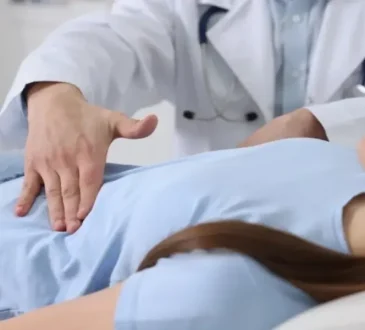
School scoliosis screening uses the Adams forward bend test. The examiner asks the student to bend forward at the waist with arms hanging and observes the upper back for asymmetry between the two sides. A rib hump or a one-sided fullness suggests that the spine has rotated along with any side-to-side curve. Screeners often use a scoliometer, a small inclinometer placed on the back, to measure the angle of trunk rotation.
The screening is a flag, not a diagnosis. A finding on the bend test prompts a referral for a standing x-ray, which is what actually determines whether a curve meets the diagnostic threshold and what the Cobb angle is. Parents who receive a referral from the school should understand that the school did not diagnose scoliosis. The school identified a finding worth checking, and the next step is imaging to determine what is actually happening.
What Parents Can See at Home
A few visual signs are worth knowing about, since not every curve is caught at school. Uneven shoulder height. A shoulder blade that sits higher or more prominently than the other. An uneven waistline, with one hip appearing more prominent than the other. A leaning posture when the teenager is standing relaxed. Clothing that does not hang evenly. Pants that fit differently on each leg. None of these signs is definitive on its own, but a combination is worth bringing to the pediatrician.
Pain is not typically the presenting symptom in adolescent idiopathic scoliosis. The condition can produce muscle tightness or fatigue, especially in larger curves, but the teenager with significant back pain and a curve usually warrants additional workup to make sure something else is not happening.
Where Chiropractic Care Fits
The honest framing matters here. Chiropractic care does not reverse a structural scoliotic curve. The Cobb angle on the x-ray reflects a structural change in the spine that no manual technique reliably reduces. What chiropractic care can do, and does well, is address the secondary issues that often travel with scoliosis. Muscle imbalance between the convex and concave sides of the curve. Restricted motion in the segments above and below the curve apex. Compensatory tension through the pelvis, hips, and shoulders. Posture habits that accelerate the underlying pattern.
Patients with mild to moderate curves often benefit from chiropractic care alongside whatever orthopedic monitoring is in place. The goals are practical. Maintaining mobility across the spine. Reducing the muscle tension that produces discomfort. Supporting the postural awareness that helps a teenager carry their body in a more balanced position. The work is not a substitute for orthopedic evaluation, bracing when indicated, or surgical consultation in the rare cases that require it. It is a complementary form of care that addresses the parts of the picture orthopedic management does not.
Cadence Chiropractic communicates with the family’s pediatrician and orthopedist when it is useful, and the care plan respects the limits of what each discipline does well.
What a First Visit Looks Like
The first visit covers a detailed history of when the curve was first identified, what imaging has been done, what the Cobb angle measured, what the Risser sign indicated, and what the family’s medical team has recommended. The exam evaluates posture, gait, range of motion across the spine, leg length, hip and pelvic alignment, and the soft tissue patterns that have developed in response to the curve.
The chiropractor at Cadence Chiropractic builds a plan around the specific findings and the goals of the family. Adjustments are gentle and selected for the age and structure of the teenager. Therapeutic massage often plays a role in managing the muscle tension that accompanies a curve. Posture education and home exercises are usually part of the conversation, since the time the teenager spends out of the office matters more than the time inside it.
When to Schedule a Visit
A few situations point toward scheduling a visit. A school screening or pediatrician finding that has not yet been followed up. A diagnosed curve that the family is monitoring and wants to support with chiropractic care. A teenager experiencing back tightness, muscle fatigue, or posture changes that may be related to a curve. A family with a history of scoliosis who wants a baseline evaluation for a young teenager entering the high-risk growth window.
Cadence Chiropractic serves families across Spanish Fork, Salem, Mapleton, Payson, and the surrounding Utah Valley communities, with chiropractors who work alongside pediatricians and orthopedists rather than around them. Book a first visit to find out what your teenager’s specific needs are and to bring chiropractic into a care picture that supports the rest of the monitoring already in place.